
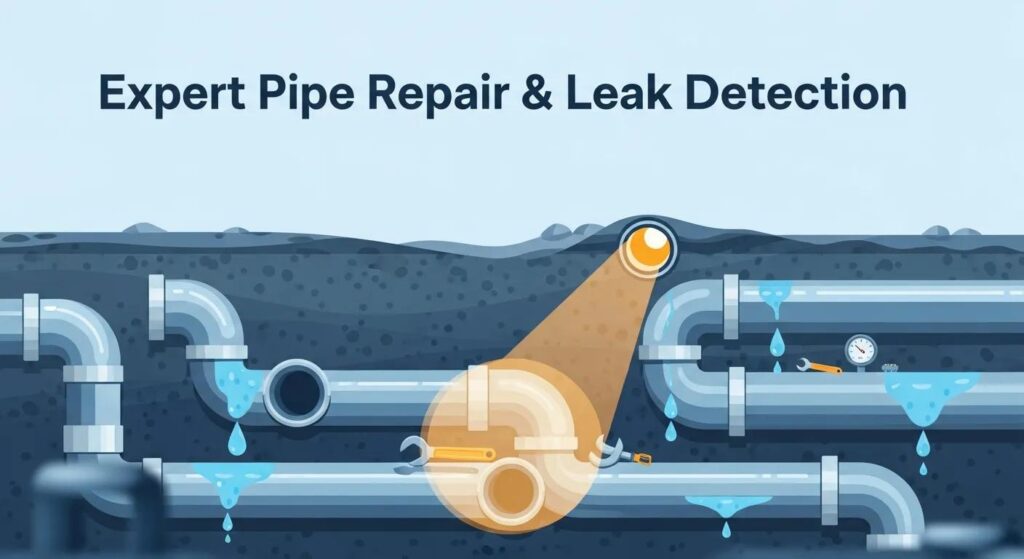
Expert Pipe Repair & Leak Detection
Hidden leaks and failing pipes share a causal relationship: accurate leak detection locates the source, and precise pipe repair addresses the root cause to prevent recurrence and reduce repair scope. This article explains how leak detection methods like acoustic sensing, thermal imaging, and video inspection connect directly to targeted repairs such as trenchless lining, excavation, and lead pipe replacement so homeowners and businesses in Macomb, Oakland, and Wayne Counties make informed decisions. Readers will learn how to recognize signs of hidden leaks, what diagnostic workflow professionals use, the repair options available for different leak types, and why early intervention protects property value and limits mold and insurance exposure. The guide also maps practical homeowner checks, typical emergency steps, and concise cost expectations to reduce uncertainty before contacting a professional. Each section uses plain language and structured comparisons so you can quickly assess risk, understand next steps, and see how professional services coordinate detection with repair for minimal disruption.
What Are the Common Signs of Hidden Water Leaks?
Hidden water leaks often present as visual, auditory, or utility anomalies that indicate water is escaping the plumbing system and causing unseen damage. Identifying these indicators early reduces water loss and prevents progression to structural harm, mold growth, or expensive emergency repairs. Below is a focused list of the most common signs to watch for and how each sign points to different leak locations or severity. Recognizing these signs is the first step in the diagnostic workflow that professionals follow, which then guides selection of the least disruptive detection and repair methods.
Common signs of a hidden leak include:
- Damp or discolored drywall: Persistent stains suggest water within wall cavities or under slabs.
- Unexplained audible water sounds: Continuous running or dripping noises often indicate pressurized leaks in supply lines.
- Sudden, unexplained spike in water bill: Continuous flow through a hidden breach can raise consumption without visible leaks.
- Wet spots in yard or sinkholes: Outdoor saturation can signal underground line failures or water main leaks.
These observable signs each point to different likely leak types and help prioritize immediate checks versus scheduled diagnostics. When multiple signs appear together—such as a high bill plus damp drywall—escalation to professional leak detection is warranted to protect property and prevent mold growth.
How Can You Identify Water Damage and Mold Growth Early?
Water damage and mold often follow hidden leaks and can begin subtly before odors or stains become obvious, so early checks focus on moisture indicators and material changes. Inspect ceiling and wall junctions for peeling paint, hairline cracks with dark edges, and a musty odor near baseboards or closets; these are reliable early indicators that moisture has been present for some time. Use a visual and tactile check—feel for soft spots, tap surfaces for hollow sounds, and look behind appliances and under sinks where leaks commonly originate. If you suspect mold or prolonged moisture exposure, document locations and timing to support insurance claims or remediation planning, then schedule a professional moisture mapping and targeted inspection.
Detecting mold early reduces remediation scope and protects indoor air quality; addressing the leak source first prevents recurrence and limits repair work. Prompt, documented action both mitigates health risk and preserves property condition before more invasive repair or replacement becomes necessary.
Why Does a High Water Bill Indicate Possible Pipe Leaks?
A sudden or sustained increase in water usage without lifestyle changes suggests continuous flow caused by leaks, meter malfunctions, or running fixtures, and the simplest home test isolates these possibilities quickly. To test at home, shut off all faucets and appliances, record the water meter reading, wait 30–60 minutes without using water, and check the meter again; any change indicates ongoing usage that likely stems from a leak. Elevated bills can also result from hidden slab leaks or underground breaks where escaping water bypasses visible plumbing fixtures, making non-invasive detection methods essential. When the meter test confirms continuous flow, the next practical step is a professional diagnostic sequence to locate the leak accurately and avoid unnecessary excavation.
Interpreting water bills alongside a basic meter test helps homeowners separate billing anomalies from true leaks, and this triage reduces time to corrective action and unnecessary service calls.
Which Advanced Leak Detection Technologies Are Used to Find Hidden Leaks?
Advanced leak detection combines non-invasive sensors and visual inspection tools to pinpoint leaks with minimal disruption, improving repair precision and lowering total restoration costs. Technicians typically start with acoustic or pressure-based screening, then use thermal imaging to map temperature anomalies and finish with video camera inspection for internal pipe confirmation; this staged approach ensures detection methods complement each other and inform the correct repair strategy. The following comparison shows core methods, how they work, and best use cases so you can understand why professionals choose one approach over another. After the table, short notes explain practical trade-offs and how combined diagnostics reduce unnecessary excavation.
Below is a concise comparison of common detection methods used to find hidden leaks:
| Method | How it Works | Best Use Case |
|---|---|---|
| Acoustic Leak Detection | Uses specialized microphones and correlators to listen for water escaping under pressure | Underground mains, supply lines in walls |
| Thermal Imaging | Detects surface temperature differences caused by moisture or leaking hot/cold lines | Slab leaks, wall leaks, concealed piping |
| Video Camera Inspection | Inserts cameras into lines for visual confirmation and location marking | Sewer lines, drains, accessible interior pipes |
This table highlights that acoustic tools excel for pressurized supply lines, thermal imaging flags non-visible wet zones, and video inspection verifies internal pipe condition before repair. Combining these diagnostics minimizes invasive work by confirming both the presence and exact location of leaks prior to excavation or trenchless repair.
When describing each detection technology, Frost & Kretsch Plumbing uses a combination of these approaches—acoustic screening followed by thermal scanning and targeted video inspection—to accurately locate hidden leaks and recommend the appropriate service cluster, such as slab leak detection or underground leak detection. Scheduling a diagnostic with trained technicians ensures the chosen method matches the leak type and access conditions.
The accuracy of leak detection and localization can be significantly enhanced through advanced methods, including machine learning. This approach leverages sensor data to pinpoint issues with greater precision.
Machine Learning for Pipeline Leak Detection and Localization
We investigate the accuracy of leak detection and localization on an experimental pipeline setup. We investigate the accuracy of leak detection and localization on an experimental pipeline setup. We investigate the accuracy of leak detection and localization on an experimental pipeline setup.
Machine-learning-assisted leak detection using distributed temperature and acoustic sensors, H Gemeinhardt, 2023
How Does Acoustic Leak Detection Work for Residential and Commercial Properties?
Acoustic leak detection detects the sound of water under pressure escaping through pipe joints, cracks, or perforations, converting sonic patterns into locational data technicians can map along pipe runs. Equipment sensitivity and correlation algorithms differ between residential and commercial contexts because larger systems produce more background noise and require more advanced filtering to isolate leak signatures. Acoustic methods are particularly effective for metallic and pressurized mains and can locate leaks beneath slabs or in landscaped yards without immediate excavation. After acoustic localization, technicians often confirm findings with thermal imaging or targeted video inspection to verify leak severity and plan the least disruptive repair.
Acoustic detection’s minimal disturbance makes it a frontline tool in a multi-step diagnostic process and naturally leads into visual confirmation when needed, ensuring that repair crews excavate only where necessary.
What Are the Benefits of Thermal Imaging and Video Camera Inspections?
Thermal imaging scans surface temperature variances caused by moisture or flowing water and is non-contact, making it ideal for detecting leaks behind walls and under slabs where surface signs are absent. Video camera inspection provides direct visual evidence by traversing the pipe interior, identifying cracks, intrusion points, or corrosion and enabling accurate mapping for repairs such as pipe lining or section replacement. Thermal imaging quickly narrows search zones, while camera inspection confirms the exact fault and assesses pipe material condition, creating a reliable basis for trenchless versus excavation decisions. Together these technologies reduce guesswork, limit property disruption, and shorten time to permanent repair.
Pairing thermal mapping with camera verification produces a diagnostic sequence that targets repairs efficiently, minimizing surface restoration needs and enabling cost-effective choices like trenchless lining when appropriate.
What Comprehensive Pipe Repair Services Address Different Leak Types?
Repair strategies vary by leak location, pipe material, and access; selecting the right repair method balances longevity, cost, and disruption. Common solutions include temporary emergency patches for bursts, trenchless lining for localized failures, full section replacement for severely damaged mains or lead pipes, and excavation where structural access mandates it. Below is a comparison table that summarizes typical repair options, their disruption level, and when each is commonly used, helping property owners anticipate the scope of work required once a leak is confirmed.
| Repair Approach | Disruption | Typical Use |
|---|---|---|
| Trenchless Lining | Low surface disruption | Localized line failure, long runs under landscaping |
| Re-piping / Section Replacement | Moderate disruption | Corroded segments, material upgrade needs |
| Excavation and Replacement | High disruption | Major failures, inaccessible piping, full water main repairs |
This comparison clarifies that trenchless methods minimize landscaping and hardscape impact, re-piping addresses material-specific problems, and excavation is unavoidable when access or damage severity requires full exposure. Understanding these trade-offs helps homeowners set expectations and prepare for restoration needs.
Frost & Kretsch Plumbing performs emergency pipe repair, water main repair, sewer and drain services, trenchless lining, excavation, and lead pipe replacement as appropriate; their teams assess detection findings and recommend the least disruptive, most durable repair solution while offering emergency response when immediate action is required. If a diagnostic confirms a slab leak or underground break, technicians will outline trenchless and open-cut options and the expected site impact so you can choose the solution that aligns with budget and restoration goals.
Trenchless pipeline rehabilitation offers an environmentally friendly and efficient approach to repairing underground infrastructure with minimal surface disruption. This method has seen significant academic development and application in recent years.
Trenchless Pipeline Rehabilitation: An Academic Review
Trenchless techniques have emerged as an efficient and eco-friendly solution for pipeline rehabilitation. The academic progress of trenchless technologies for underground pipeline rehabilitation is reviewed in this paper.
Development of trenchless rehabilitation for underground pipelines from an academic perspective, H Lu, 2024
How Are Emergency Pipe Repairs Handled for Burst and Frozen Pipes?
Emergency response begins with isolating the leak to stop ongoing water flow, followed by a rapid assessment to determine whether a temporary fix or permanent repair is immediately necessary. Homeowner steps include shutting off the main valve if safe, turning off electricity in affected areas, and documenting damage for insurance, which aids the technician’s initial triage on arrival. Emergency crews then stabilize the situation—installing clamps or bypasses, pumping water from affected areas, and mapping repair needs—before scheduling full replacement, lining, or excavation based on diagnostic confirmation. Clear communication and upfront estimates reduce surprises and allow homeowners to prioritize restoration and mitigation work quickly.
Stabilizing water flow and minimizing structural damage are the primary goals in emergency scenarios, and a coordinated diagnostic-to-repair workflow ensures that temporary measures are converted to durable solutions once the leak is precisely located.
What Are the Options for Water Main, Sewer Line, and Lead Pipe Repairs?
Water main and sewer line repairs range from spot lining and pipe bursting to full replacement depending on age, material, and failure mode, while lead pipe replacement follows public health guidance to remove legacy materials. Trenchless options such as cured-in-place lining and pipe bursting offer lower surface disruption and faster timelines for long runs, whereas excavation and section replacement provide a straightforward solution when trenchless methods are unsuitable or when multiple service lines need replacing. Decisions weigh cost, expected service life, regulatory considerations for lead, and restoration impact on landscapes or driveways. Recent regulatory attention on lead pipe replacement has made material assessment a standard part of the repair consultation.
These repair choices balance durability and disruption: choosing trenchless when feasible preserves property features, while excavation ensures complete material removal where public health or structural factors require it.
Why Is Early Leak Detection Critical to Prevent Costly Water Damage and Mold?
Early detection limits water exposure time, reducing structural damage, mold colonization, and the scale of insurance claims, which together drive restoration costs dramatically higher when leaks persist. Detecting leaks before they penetrate finishes preserves drywall, flooring, and structural members, and limits the volume of contaminated water exposure that increases remediation complexity. From a financial perspective, timely detection often converts a major remediation project into a targeted repair with lower direct costs and less interruption to occupants. The next subsection explains how documented repairs and prompt mitigation protect property value and improve outcomes for insurance processes.
Preventative detection also conserves water and reduces ongoing loss, which is increasingly important for both residential and commercial properties in the current regulatory and environmental climate.
How Does Timely Pipe Repair Protect Property Value and Reduce Insurance Claims?
Documented, prompt repairs demonstrate proactive maintenance to future buyers and insurers, preserving resale value by preventing chronic dampness, mold, and structural degradation that often deter purchasers. When homeowners act quickly, insurers may view the claim as a mitigable event with limited secondary damage, and well-documented mitigation—photos, repair invoices, and diagnostic reports—supports smoother claim processing. Timely intervention also reduces the scope of restoration work required, lowering both immediate repair costs and long-term depreciation tied to unresolved moisture issues. Maintaining records and working with qualified technicians facilitates both claim resolution and potential negotiation with insurers on coverage for repair versus replacement.
Prompt, well-documented repairs therefore protect value and simplify insurance interactions, creating a stronger position for homeowners during post-loss remediation and resale.
What Are the Risks of Ignoring Small Leaks in Older Plumbing Systems?
Small leaks in older systems act as progressive failure points: slow corrosion expands, hidden moisture fosters mold, and repeated freeze-thaw cycles in colder months can convert a small loss into a catastrophic burst. Older materials—galvanized iron, lead, or brittle plastics—have higher failure risk and may conceal multiple weak points, making targeted replacement planning essential. Ignoring minor leaks often increases the eventual repair scope from a localized patch to extensive re-piping, structural remediation, and mold abatement, raising both direct and indirect costs. Regular inspection cadence and timely replacement strategies for known-vulnerable materials reduce the likelihood of emergency failures and long-term damage accumulation.
Addressing small leaks early protects structural integrity and occupant health while avoiding compounding costs and emergency interventions down the line.
Why Choose Frost & Kretsch Plumbing for Pipe Repair and Leak Detection Near Me?
Frost & Kretsch Plumbing provides local, licensed, and insured technicians serving Macomb, Oakland, and Wayne Counties who combine advanced detection techniques with practical repair options to minimize disruption and restore service efficiently. The company emphasizes prompt assessment, transparent pricing with upfront estimates, and 24/7 emergency services so property owners can secure timely diagnostics and repairs when timing matters most. Technicians receive ongoing training in acoustic, thermal, and video inspection methods to align detection results with cost-effective repair choices like trenchless lining or targeted excavation. These service attributes aim to leave properties clean and functional, backed by a satisfaction-focused approach that clarifies options and expected impacts before work begins.
This local focus and combination of diagnostic rigor plus repair flexibility helps customers choose the most appropriate, least disruptive repair path based on accurate leak localization.
What Makes Our Licensed and Insured Technicians Reliable for Macomb, Oakland, and Wayne Counties?
Licensed and insured technicians reduce liability for homeowners and offer verified proficiency in safety and repair standards, while ongoing education ensures crews stay current with detection and trenchless repair advancements. Frost & Kretsch’s teams apply documented diagnostic workflows—acoustic screening, thermal imaging, and camera verification—to translate detection data into precise repair plans that limit excavation and surface restoration. Local experience across Macomb, Oakland, and Wayne Counties gives crews practical knowledge of common material types and soil conditions that influence repair choice and site management. This combination of verifiable insurance coverage, licensing, and continuing training supports predictable outcomes and clearer conversations about cost and disruption.
Reliability therefore stems from formal protections, documented processes, and local experience that together streamline diagnostic-to-repair transitions and reduce surprises during restoration.
How Does Transparent Pricing and 24/7 Emergency Service Benefit Customers?
Transparent pricing with upfront estimates reduces billing disputes and helps homeowners compare repair paths like trenchless lining versus open-cut replacement based on clear scope and cost implications. Around-the-clock emergency availability prevents minor leaks from escalating during off-hours by enabling immediate stabilization and temporary measures that limit property damage. Together, clear pricing and rapid response shorten downtime, reduce restoration scope, and give property owners control over repair timing and budget trade-offs. For urgent situations, this approach prioritizes immediate mitigation followed by a planned permanent repair, which often results in lower total cost and less invasive work.
These service guarantees provide practical peace of mind and make it easier to act quickly when leaks threaten property and safety.
Frequently Asked Questions
What preventive measures can homeowners take to avoid pipe leaks?
Homeowners can take several preventive measures to minimize the risk of pipe leaks. Regularly inspect plumbing systems for signs of wear, such as corrosion or rust, especially in older homes. Insulating pipes in colder areas can prevent freezing and bursting during winter. Additionally, maintaining consistent indoor temperatures and monitoring water pressure can help reduce stress on pipes. It’s also wise to schedule routine plumbing inspections with professionals to catch potential issues early, ensuring a proactive approach to leak prevention.
How can I prepare for a plumbing emergency?
Preparation for a plumbing emergency involves several key steps. First, locate your main water shut-off valve and ensure all household members know how to operate it. Keep essential tools, such as a wrench and plunger, accessible for minor issues. Create a list of emergency contacts, including your plumber and insurance provider, and store it in an easily reachable place. Additionally, document any plumbing issues and repairs to provide your plumber with a clear history during emergencies, which can expedite the response and repair process.
What should I do if I suspect a leak but can't find it?
If you suspect a leak but cannot locate it, the best course of action is to contact a professional plumber. They can perform advanced leak detection methods, such as thermal imaging or acoustic detection, to identify hidden leaks without invasive measures. In the meantime, monitor your water meter for unusual spikes and check for signs of water damage, such as damp spots or mold. Documenting these observations can help the plumber diagnose the issue more effectively when they arrive.
Are there any health risks associated with mold from water leaks?
Yes, mold growth resulting from water leaks can pose significant health risks. Mold spores can trigger allergic reactions, respiratory issues, and other health problems, particularly in individuals with asthma or weakened immune systems. Prolonged exposure to mold can lead to more severe health complications, including chronic respiratory conditions. Therefore, it is crucial to address leaks promptly and remediate any mold growth to protect the health of all occupants in the home.
How can I choose the right repair method for my plumbing issue?
Choosing the right repair method for plumbing issues depends on several factors, including the type of leak, pipe material, and accessibility. For minor leaks, temporary patches may suffice, while more severe issues might require trenchless lining or full pipe replacement. Consulting with a licensed plumber can provide insights into the most effective and least disruptive repair options. They can assess the situation and recommend a method that balances cost, longevity, and the impact on your property.
What are the long-term benefits of timely leak repairs?
Timely leak repairs offer numerous long-term benefits, including reduced water bills, prevention of structural damage, and avoidance of mold growth. Addressing leaks promptly helps maintain the integrity of your plumbing system, extending its lifespan and reducing the need for costly replacements. Additionally, timely repairs can enhance property value by preventing chronic issues that deter potential buyers. Overall, proactive maintenance fosters a healthier living environment and can lead to significant savings over time.
How Much Does It Cost to Fix a Leaking Pipe Near Me?
Costs vary by leak type, access difficulty, repair method, and required restoration; typical localized repairs can be modest while full replacements or extensive excavation increase costs substantially. Below is a practical cost-range table to set expectations for common scenarios, noting that on-site assessment is required for accurate estimates.
| Repair Type | Typical Cost Range | Notes |
|---|---|---|
| Localized repair (accessible supply line) | $150–$600 | Quick fix, minimal restoration |
| Trenchless lining (section of main/sewer) | $1,000–$4,000 | Lower surface restoration costs |
| Excavation & section replacement | $2,000–$8,000+ | Includes restoration of landscaping or hardscape |
These ranges reflect common outcomes and the primary cost drivers; final pricing depends on material, depth, required permits, and restoration needs. For precise pricing, schedule an on-site diagnostic so technicians can combine detection results with repair options and provide a transparent estimate.
How Do Plumbers Detect Leaks Behind Walls and Underground?
Professional detection follows a staged diagnostic flow: visual inspection → non-invasive testing (acoustic and thermal) → video camera confirmation → targeted excavation if necessary. Acoustic and thermal methods quickly narrow search zones without surface removal, while camera inspection verifies internal pipe issues and pinpoints segments needing repair. Targeted excavation follows only when non-invasive tools indicate a precise location or when camera inspection shows failures that require physical access. This staged approach minimizes property disruption and ensures repairs are based on verified evidence rather than conjecture.
Following this flow improves repair accuracy and reduces the risk of unnecessary excavation, saving time and restoration costs.
Can Small Leaks Cause Burst Pipes or High Water Bills?
Yes; persistent small leaks continuously expose pipes and surrounding materials to moisture, accelerating corrosion, soil erosion, or freeze damage that can culminate in a burst. The cumulative water loss from a pinhole leak translates into higher bills over time, and unseen leaks under slabs or in walls can waste hundreds of gallons daily depending on pressure and breach size. Monitoring meter readings and acting on early signs such as damp spots or sound of running water prevents escalation and reduces both utility waste and the likelihood of catastrophic failure. Repairing small leaks promptly is a cost-effective step that mitigates larger replacement or remediation expenses later on.
Proactive monitoring, basic meter tests, and timely professional diagnostics form a simple defense against expensive, avoidable consequences.
Frost & Kretsch Plumbing offers 24/7 emergency diagnostic and repair dispatch for residents and businesses in Macomb, Oakland, and Wayne Counties; to schedule a diagnostic, request emergency service, or discuss repair options, contact their team and describe the symptoms you’ve observed. Trained technicians will explain recommended detection steps, present repair alternatives with transparent pricing, and prioritize solutions that minimize disruption while restoring safe, reliable service.
Conclusion
Effective pipe repair and leak detection are essential for safeguarding your property from costly water damage and mold growth. By utilizing advanced technologies and prompt service, homeowners can minimize disruption while ensuring long-term solutions. Understanding the signs of leaks and the available repair options empowers you to take proactive measures. For expert assistance and to explore our comprehensive services, reach out to Frost & Kretsch Plumbing today.